basics Grundlagen | stars Sterne
 

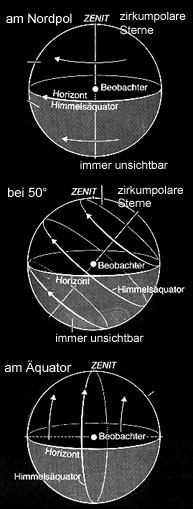
The starry sky surrounds the earth like a sphere with infinite radius, with the observer sitting in its center. The star constellations appear to be projected onto this surface. In this model of sky- and earth-sphere the movements of the different star constellations are easy to understand and imagine.
If you project the equator of the earth onto this sphere, it is split into a northern and a southern hemisphere. This line on the celestial sphere is called zodiac. On this track move sun, moon and the planets.

The apparent rotation of the celestial vault is caused by the rotation of the earth around its axis. The intersections of the elongated earth axis with the celestial sphere are called celestial poles. Their connection line is called earth or celestial axis.

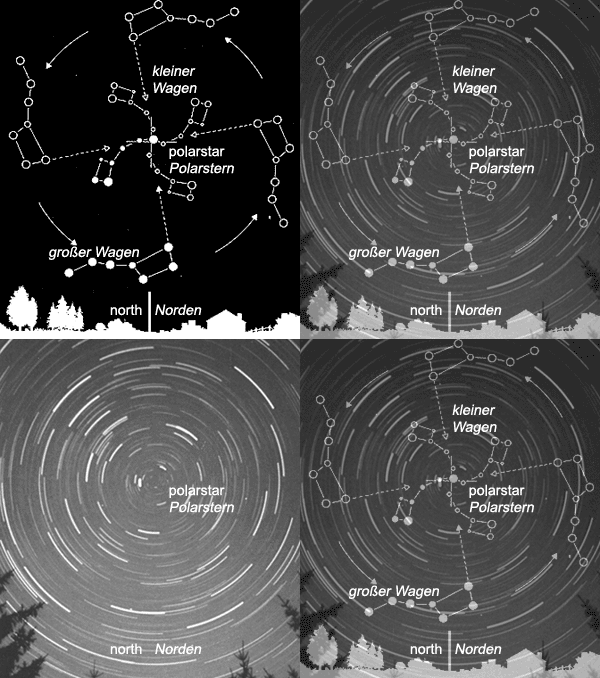
Circumpolar stars are stars that can be observed all the year round. At the poles this applies for the complete sky. At the equator there are no circumpolar stars and moving from there towards one of the poles the amount of circumpolar stars is increasing. This results in the situation that stars move parallel at the north pole, perpendicular at the equator and slanted according to the horizon in between. The polestar is located approximately in the center of the orbital movement at the northern sky. The probably most known circumpolar constellation on the northern hemisphere is the Big Dipper or Great Bear.
Der Sternenhimmel umgibt die Erde wie eine Kugel mit unendlichem Radius, in deren Zentrum sich der Beobachter befindet. Die Gestirne scheinen auf diese Kugelfläche von innen projiziert zu sein. Mit Hilfe der (gedachten) Himmelskugel und der Erdkugel lassen sich die Gestirnsbewegungen leicht klarmachen.
Bildet man den Erdäquator auf diese Kugel ab, wird sie in eine nördliche und eine südliche Halbkugel geteilt. Diese Linie am Sternenhimmel nennt man auch die Ekliptik oder den Tierkreis. Auf dieser Bahn bewegen sich Sonne, Mond und die Planeten.
Die scheinbare Drehung des Himmelsgewölbes wird durch die Drehung der Erde um ihre Achse hervorgerufen. Die Schnittpunkte der verlängerten Erdachse mit der Himmelskugel sind die Himmelspole, ihre Verbindungslinie ist die Himmels- oder Weltachse. (nach 7)

Zirkumpolar werden die Sterne genannt, die man an einem bestimmten Ort das ganze Jahr hindurch beobachten kann. An den Polen gilt dies für den gesamten Himmel, am Äquator gibt es keine zirkumpolaren Sterne, und dazwischen nimmt der Anteil an zirkumpolaren Sternen zu, je weiter man zum Pol vordringt. Am Nordpol bewegen sich die Sterne parallel, am Äquator senkrecht, dazwischen schräg zum Horizont. Im Zentrum der Kreisbewegung am nödlichen Sternenhimmel befindet sich annähernd der Polarstern. Das wohl bekannteste zirkumpolare Sternbild auf der nördlichen Halbkugel ist der Große Bär bzw Große Wagen.
(nach 3)


Teresa Karayel - © 2002    Stand: 08.12.2004 contact